

-
Trade wars: Both U.S. and China have agreed to a temporary cease-fire and tariffs will not be raised for 90 days. However, how both sides reported the news differed.
A brief overview of how the trade war has panned out (Source):
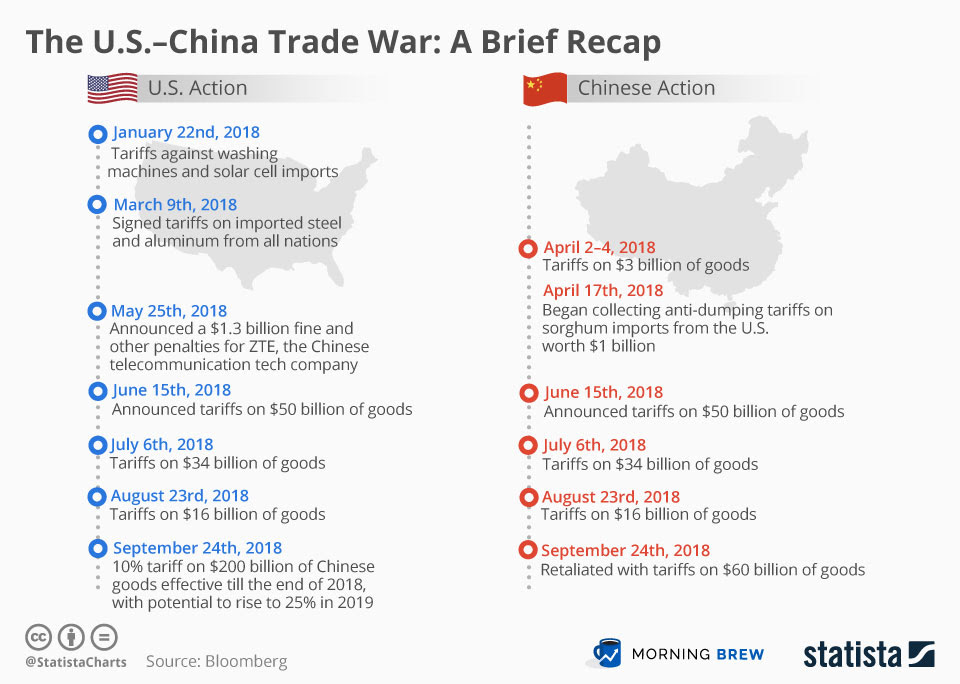
“After a dinner which both sides called “highly successful,” White House Press Secretary Sarah Huckabee Sanders and Chinese Foreign Minister Wang Yi released parallel and rarely overlapping statements. The U.S. listed what China had agreed to in exchange for a 90-day pause in raising tariffs on Chinese goods, while Beijing focused on the broad reduction in trade tensions, without going into specifics.”
Read the full article with a side-by-side comparison on Bloomberg: The U.S. and China’s Trade Truce Statements, Compared
-
Airspace territory dispute: Malaysian government wants to negotiate to retake their rights over Johor airspace, after Singapore’s announcement of a publication of Instrument Landing System (ILS) procedures for Seletar Airport
“The Malaysian government wants to reclaim its “delegated airspace” in southern Johor, its Transport Minister Anthony Loke told parliament on Tuesday (Dec 4).
Citing concerns over sovereignty and national interest, the minister said Malaysia will discuss its plans in greater detail with Singapore, and if necessary refer to the International Civil Aviation Organization (ICAO) for further advice.
Mr Loke said Malaysia informed Singapore on Nov 29 regarding its plan to “reclaim its sovereign airspace in phases”, with the first stage expected around the end of 2019 and the next stage in 2023.
“The plan to reclaim Malaysia’s delegated airspace in southern Johor needs to be done in stages in order to coordinate the air traffic control service arrangements between the air navigation service providers in both countries to ensure safe, efficient and organised aircraft movement,” Mr Loke said.”
Read the full article on ChannelNewsAsia: Malaysia wants to ‘reclaim delegated airspace’ in southern Johor
-
Public health research: A new portable device is developed to detect common airborne viruses, introducing procedures that could potentially reduce time needed to contain the disease from spreading.
“The method can potentially detect viruses in a population much faster than screening patients seeking medical care at clinics or hospitals, which can take several days.
If similar samplers are deployed at airport checkpoints or other high-risk crowded places, potential biological threats such as Sars and the H7N9 strain of bird flu could be detected in eight hours or less, Dr Coleman told media yesterday.
“A lot of the time, once we know that a pandemic is present, it is often too late and it can spiral out of control. If we can detect it earlier, we can start controlling it right away,” she added.”
Read the full article on The Straits Times: Detecting viruses on MRT with portable device
Picture credits:https://unsplash.com/photos/AXsJBByg4Ic