
Book In Summary
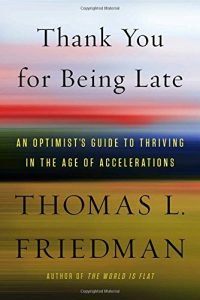
The subtitle of the book tells it all: It is an ‘Optimist’s Guide to Thriving in the Age of Accelerations’. In our world today, three accelerating forces are combining to make the pace of change much more exponential compared to previous eras: technology, markets and climate change. In the last decade, technological accelerations (as described by Moore’s Law) contributed to, and coincided with accelerations in the market, evidenced by increased global commerce, rapidly growing social networks and an information tsunami. Added to this, nature is experiencing an acceleration in the form of climate change and population explosion.
So what this means for humanity is that we are living in a time of constant adaptation. In fact, if earlier epochs in history were characterized by occasional destabilization, our modern one is one of near-constant destabilization; we humans must constantly re-evaluate our ecosystem, remaining agile in order to adapt to a rapidly changing world. Rather than a static stability, we need to expect a dynamic stability, like the one we experience while riding a bicycle: it is not the kind of stability that lets you stand still, but it will keep you afloat if you stay in motion.
Not just tangible flows
The globalized market that we live in is not just about manufacturing and trading goods; it is also about exchanging information and making financial transactions online. Consider the flow of data through Facebook, the exchanges between renters and travellers on Airbnb and the incessant stream of opinions on Twitter.
Such global digital flows have made the world much more interdependent on all fronts: financially, culturally and politically. For instance, when the author spoke to Facebook in May 2017, Facebook Messenger was poised to add its one billionth user. In the same year, Twitter had 328 million active users every month. That’s more than the entire US population!
It’s this level of interconnectivity that enables products to go viral at a scale and speed that was unfathomable in past generations. For example, in 2012, a photo of Michelle Obama wearing a dress from the online fashion store ASOS was retweeted 816,000 times and the dress instantly sold out.
Accelerating climate change
One does not need to be a meteorologist to know that the weather has been out of control in recent years; a scorching, record-high heat index of 74 degrees Celsius was recorded in a city in Iran in 2015, while traditionally frigid winter locations are experiencing milder and milder temperatures over the years. These are tangible reminders that climate change is here and not going to go away.
To make matters worse, there is no sign that climate change will slow down. According to the United Nations, by 2050, the world population is expected to rise from around 7.2 billion today to 9.7 billion. All these additional people will mean more homes, more water, more cars and more electricity consumption and a far greater carbon footprint.
A mixed bag
The age of acceleration may bring up some issues, but it has also enabled individuals to work toward the common good. In the end, while it is a mixed bag, there is good reason to be optimistic.
Technology and globalization have made it possible for anyone with a basic education and access to the Internet to help humanity make collaborative decisions, while also handling the challenges these same trends produce. Each of us, no matter where we are, must abandon the selfish, narrow-minded outlook that has been instilled in us and help pave the way to an equitable and dignified society.
Meaningful quotes:
“Nothing in life is to be feared, it is only to be understood. Now is the time to understand more, so that we may fear less.”
“When you press the pause button on a machine, it stops. But when you press the pause button on human beings they start…You start to reflect, you start to rethink your assumptions, you start to reimagine what is possible and, most importantly, you start to reconnect with.”
“The rabbi stated: When you look into the face of the person who is beside you, and you can see that person is your brother or your sister, then finally the night has ended, and the day has begun. Hastening that heavenly day, is the moral work of our generation.”
Relevant for:Globalization, Media, Environment, Technology, Modern Society